
People call us when a tree has started to lean, when limbs are hanging over a roof, when roots got cut or buried during excavation, or when a build needs the trees and the site documented before anything starts.
What does an arborist report cost?
Construction-related arborist reports in Evansville fall between $375 and $950. Straight Edge Tree Services can talk through a ballpark on the call, and the exact number is confirmed after we have seen the tree and the site. Tree count and the amount of ground to document move the price within that span.
One tree on flat, clear ground is a smaller job than several trees on a sloped lot where the soil changes underfoot, or a site where nearby tree cover has changed and the write-up has to explain it. The figure covers inspecting the tree and the site and writing it up.
Worth comparing with tree removal. Searching for tree service in Evansville? Our home page covers it.
Before you book: The Tree Service Timeline: What Each Step Involves · Comparing Tree Service Quotes: What Is Worth Checking
What signs mean a tree needs looking at?
A lean that was not there last year, soil lifted or cracked at the base, dead limbs in the crown, or roots cut and covered during excavation are all reasons to call Straight Edge Tree Services out to look at a tree in Evansville. Anything hanging over a roof, drive or walkway should be looked at sooner rather than later.
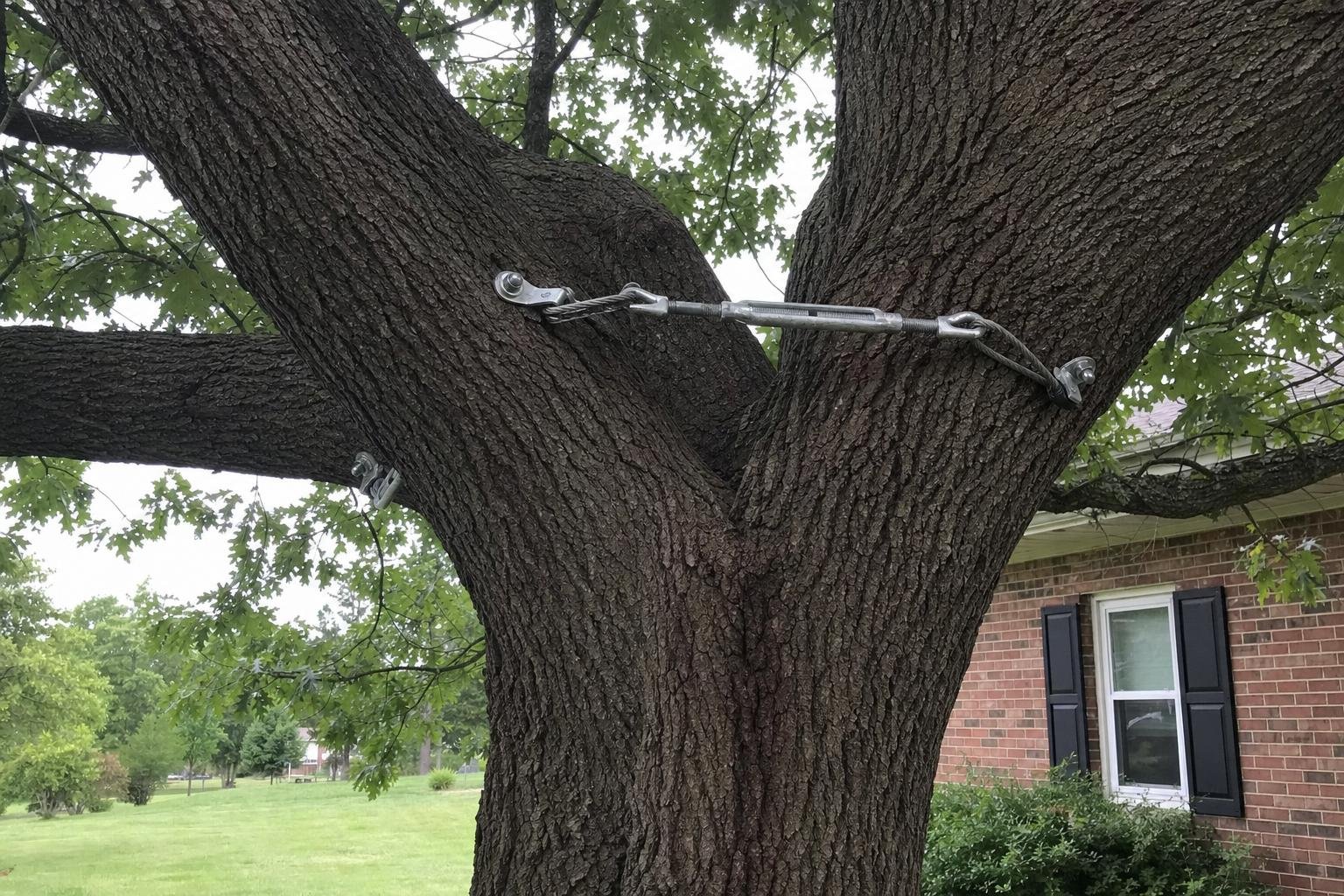
From the ground we look at the buttress roots where they meet the soil, the trunk, the branch unions and the crown. Binoculars do the top half of that work, because the limb that fails is often the one you would have to stand under to see.
A tree does not have to be leaning to be worth a look. If there has been grading, drainage work or excavation within reach of the roots, or if tree cover nearby has come down and the wind now hits the tree differently, walk it with us. Same if the ground around the base has softened or water stands there after a wet stretch.
What happens during the site visit?
Straight Edge Tree Services walks all the way around every Evansville tree, reading the buttress roots first, then the trunk and branches, then the crown. Binoculars go up for the crown, a mallet comes out for the trunk, and we take notes on the ground the tree is standing in.
A defect on the far side of the trunk will not show from the driveway, and the side facing the neighbors is the side nobody looks at. Sounding the trunk with a mallet tells us where the wood is solid and where it rings hollow, which a photograph or a phone description cannot.
Alongside the tree we document the site: the slope, where the soil changes, and whether tree cover nearby has changed. All three affect how likely a tree is to fail, so they go in the record whether you are planning a build or just deciding whether to keep the tree. When the visit is done we write it up so you have something to hand a builder or anyone else who wants to know why you are worried.
How long does the job take?
How long depends on the tree count, the slope and soil, and why you called. Straight Edge Tree Services tells Evansville customers what a visit involves before scheduling it, and a written report adds office time on top of the time on site. If you have a construction date, tell us first, because it sets the order we work in.
Several trees on one lot take longer than one. A sloped site, or one where we have to walk and describe changes in the soil, takes longer than flat open ground. Soft, saturated ground can slow even getting to the tree.
Giving us the construction date early means the report is done before the excavator arrives, not after.
How do Evansville ground conditions change the job?
Wet soil is the main local factor. Soil in parts of Evansville is poorly drained, with the water table near the surface in the wet season and brief ponding in normal conditions. Straight Edge Tree Services checks ground firmness before bringing heavy equipment onto a site, and keeps it off if the ground is soft.
A rutted, compacted root zone is damage we would have caused and cannot undo. On the floodplains in Vanderburgh County the ground is also somewhat poorly drained and slowly permeable, so saturated soil there can make access difficult in a way that has nothing to do with the tree itself.
Hard winter freezes here freeze and thaw the ground over and over, which strains concrete and underground lines. A tree growing close to a slab, a foundation or a pipe run gets that noted in the site record.
What Goes Into the Work
In plain terms, a few parts of the job:
- Inspect the tree and surrounding site from the ground, walking 360 degrees around it and viewing the buttress roots, trunk, branches, and crown.
- Record visible health and structural concerns in the crown, branches, trunk, root collar, roots, and soil; use inspection tools when appropriate.
Related Services
Questions Welcome
A conversation on the phone is the easiest start, and you'll hear back with a plain answer.