


Dead or broken branches
What's behind it: Limbs can be dead, diseased, weakened, or storm-damaged.
What we check first: Inspect the affected branches and their attachments.
Tell us what you need done, you'll get a straight answer and a free quote in Evansville.
Fast Scheduling
Ring us and describe what's going on, and it costs nothing to ask.

No obligation
Call (930) 212-1312From here
We're a tree crew working across Evansville. The jobs run from one limb hanging over a roof to a whole lot cleared for a new build. The first visit is a walk around the lot, and what's overhead, underfoot and next to the tree sets the method, the equipment and the quote.
Evansville has a real mix of housing: older Queen Anne, Craftsman, Colonial Revival and Foursquare houses, and postwar ranch homes. The trees around them were planted long before anyone drew a service drop or a fence line. One lot gives us a wide side yard and a clean drop zone. A lot four blocks away gives us a fence, a shed, a power line and a driveway with nowhere to put a limb. Same job, different day's work.
What's under the tree changes how we rig. Plenty of the ranch homes here, in Hebron Meadows for example, have brick or stone veneer and asphalt-shingle roofs. Working over a shingle roof is not the same problem as working beside a veneer wall, and we plan the lowering and the landing spot accordingly.
The ground is the other half. Local soils are silty loam and silty clay, and the water table is generally high. Near the central bend of the Ohio River the soil is poorly drained Weinbach silt loam, and wet ground there can make it hard to get equipment in. A loaded truck or chipper on soft ground will rut a lawn, so we sort out the access on the walk-through. Sometimes that means a smaller machine and sometimes carrying brush out by hand. We live with hot summers and real winters (climate zone 4A), and the trees show both.
Removals and pruning are the core of it. That covers a dead tree, one leaning the wrong way, a canopy grown into the roofline, and routine cutting back to keep a mature tree off a structure. We take the small jobs too, one limb or one overgrown side of a yard, because those are the ones that turn into something worse if they sit.
Storm damage is its own kind of call. When a limb is already on a roof or a cracked trunk is hanging over a driveway, our first job is to look at what's actually holding weight, because a limb under tension behaves nothing like a free one. A tree already on the ground is usually the easy half.
We also clear lots for a build, a drive, a fence or a pad, and haul the material off site. Stump grinding, commercial grounds and firewood come up on a lot of jobs, and they're covered below.
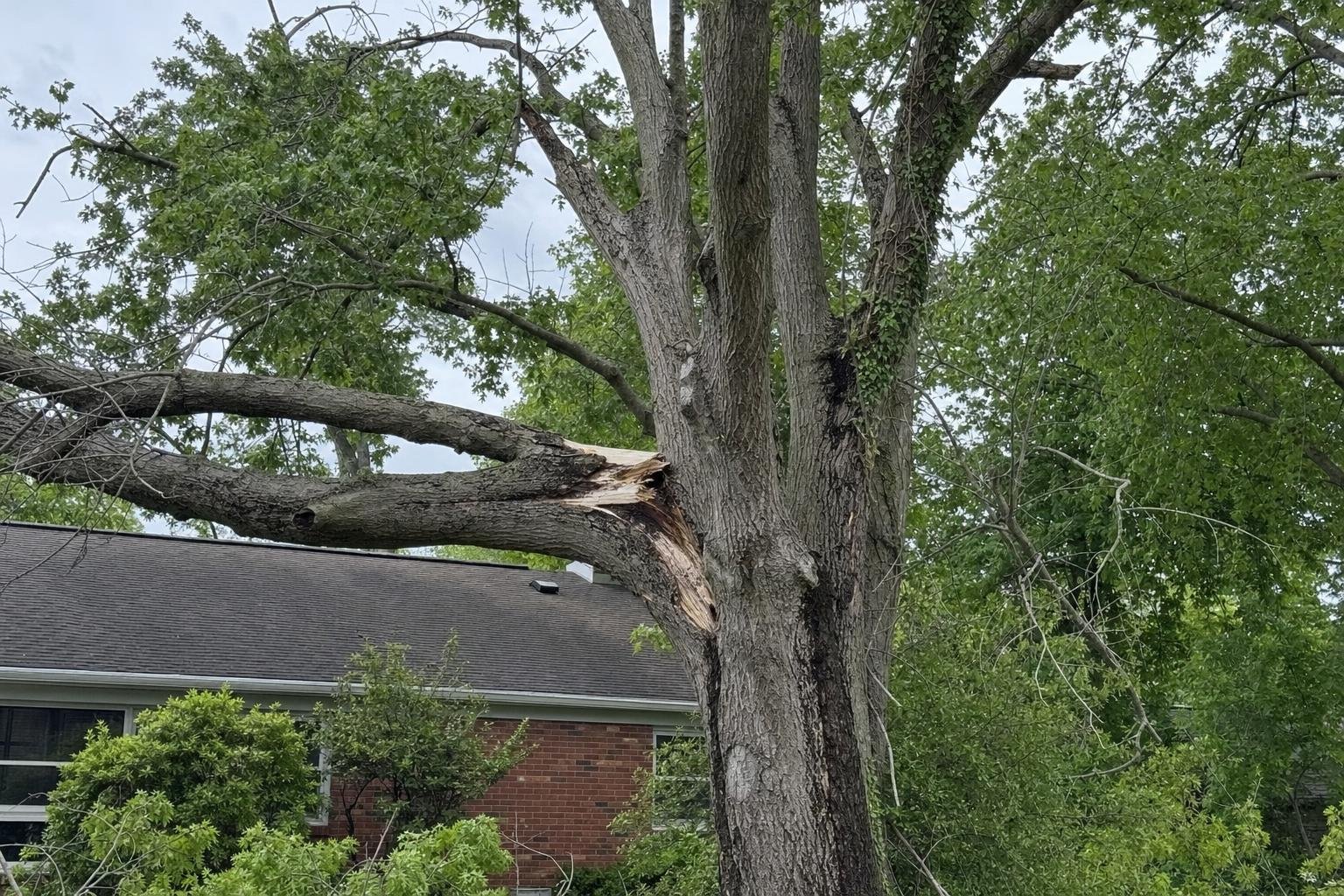
Every job starts with a walk of the site. We look at overhead lines and where they run, damaged limbs and which way they hang, how the tree leans, what structures and fences are within reach of anything we cut, traffic if the work is near the street, and whether the ground is stable enough to set up on.
After the site, the tree gets its own inspection before any method is chosen. Health and structure come first: a tree has to be able to hold a climber, a rigging line or the load of a cut before we put any of those on it. A sound tree can take a climber and a rigging line. A hollow or cracked one may have to be worked in small pieces from the ground. Once we know, the sequence is simple: what comes off first, where it lands, what gets rigged and lowered, what gets cut and carried, then cleanup and, if you want it, the stump.
Price comes out of the same list: how big the tree is, what stands close to it, whether lines are in the way, how much has to be roped down instead of dropped, what the ground allows, how much hauling there is, and whether the stump and wood are part of the job. Our written quote lists what's included, and the final number is set after we've seen the job.
A removal leaves a stump at grade that you mow around for years. Grinding it is separate work with its own machine, and it's easiest to decide before the tree comes down, while we're already planning access.
A stump grinder is not small. On a narrow side lot with a fence on one side and a house on the other, getting it to the stump can be half the job. If you want the stump out, say so during the walk-through; whether the grinder fits through to it gets settled then. Most people just want the obstacle out and the ground usable again.
On the commercial side we work on rental properties, storefronts and lots, where a limb over a sign or a walkway is a liability and not just a nuisance. The cutting is the same, but the scheduling isn't. Parking and deliveries have to keep moving, and the drop zone has to land away from customers and cars, so we plan those around how the property is used.
Firewood means the wood goes to a stack rather than into the chipper. Whether we're cutting to stove length or feeding a chipper changes how we work the tree on the ground, so tell us before we start if you want it kept and where you want it stacked. If you don't want it, we haul it and leave the yard clean.
Tell us what's near the tree: the house, a garage, a fence, the driveway, the lines, a shed you forgot about. Tell us whether the tree is standing or down, whether anything is resting on a structure, and whether the ground under it holds water. A site visit follows. Plenty of people find the job is smaller than they feared, and a tree they were ready to lose only needs a couple of limbs off the side that's grown into the roof. Which of those it turns out to be gets settled once we're under the canopy.
These numbers are a reasonable place to start, and the specifics of yours decide where in the range you land.
$425–$1,150
$125–$475
$95–$150
What each option is good for, in plain terms.
The process is short and the same every time:
A short call is enough to tell us what the job is and what it involves.
We look at the job on site, then confirm exactly what the job involves.
The scope, the timeline, and the price go on paper before any work starts. No surprises.
We do the work as quoted. You see everything we did.
No obligation
Call (930) 212-1312From here
Based in Evansville, IN and the nearby communities, Melody Hill, Newburgh, and Chandler among them. Call (930) 212-1312 to confirm we reach your neighborhood.
4 communities on the list.
ZIP codes: 47715, 47711, 47714, 47710, 47712, 47713, 47708.
Each one has a usual cause, and we check for it before quoting a fix.
What's behind it: Limbs can be dead, diseased, weakened, or storm-damaged.
What we check first: Inspect the affected branches and their attachments.
What's behind it: A strong lean may indicate a stability issue, while root disturbance, decay, or weak attachments can play a part in tree failure.
What we check first: Check the lean, root zone, trunk, and main branch attachments.
What's behind it: High winds or storms can break branches or bring down trees.
What we check first: Assess the damaged tree and nearby hazards before deciding what to prune or remove.
Leaving a stump invites pests, diseases, and fungal growth that can spread to healthy trees. It also creates a tripping hazard and can sprout unwanted suckers, ruining your landscape.
In many areas, yes. Check with your local municipal office or homeowner association for regulations, especially for large trees, protected species, or trees near power lines.
Late winter or early spring, just before new growth begins, is ideal for most trees. This timing minimizes stress, promotes healthy recovery, and reduces disease risk.
Prices vary widely by region and company. To find affordable rates, compare quotes from multiple licensed, insured providers in your area, ensuring they include full services like hauling and disposal.
Removing a 40-foot tree typically costs between $375 and $750. Factors like proximity to buildings, accessibility, and whether the stump is ground affect the final price.
Free Quotes, fast scheduling, (930) 212-1312.
Serving Evansville, IN and surrounding areas.